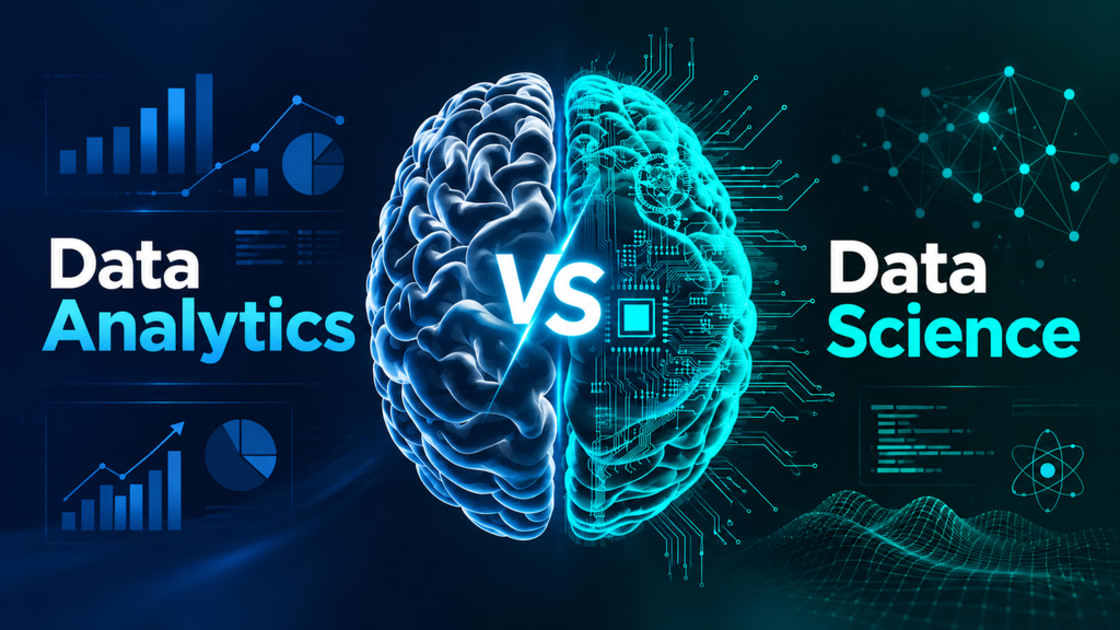
People ask me this a lot, usually when they've just started looking at job websites or a course list and see both terms in the same five minutes: "Wait, isn't data science just data analytics with extra steps?"
Kind of. But not really.
These two fields get mixed up so often that people think they're the same job with two different names. They're not. They ask different questions, use different tools most of the time, and often attract different kinds of people. Let me explain how I think about the difference, because once it makes sense, it stays simple.
Data Analytics vs Data Science in One Sentence
Data analytics is about understanding what already happened. Data science is about guessing what will happen next. It often builds something that acts on that guess by itself.
Here's a simple way to picture it. An analyst looks backward to explain why last month's numbers looked the way they did. A data scientist tries to build something that can see a little bit ahead, before it actually happens.
Neither one is "better." They just solve different problems. Once you see them as two different tools instead of two versions of the same tool, the whole topic gets a lot easier to understand.
What Is Data Analytics?
Data analytics is the practice of looking at data that already exists and pulling clear answers out of it. It's less about building new technology and more about asking the right questions and knowing where to look for the answers.
Picture someone who gets a question, like "why did fewer people finish buying things on our site last month?" They have to find the answer using data the company already has sitting in its systems.
That usually means pulling data using SQL, cleaning it up in a spreadsheet (it's almost always messier than expected), and then turning it into something easy to look at, like a dashboard in Tableau or Power BI, so the marketing team or a manager can understand it without needing to know statistics. There's often some testing involved too. Did the drop happen because of the new website design, or was it something else, like a payment problem nobody noticed?
At the end of the day, an analyst's job is to turn a bunch of numbers into a simple story someone can use. The tools are usually SQL, Excel, Tableau, or Power BI, and sometimes a bit of Python or R for harder tasks.
Data analytics work is usually more short-term and focused. Someone asks a question today, and the analyst finds an answer this week. The value shows up fast, which is one reason so many companies hire analysts early, even before they have a full data team.
A few examples of what a data analyst might handle in a normal week:
Building a dashboard that tracks weekly sales by region
Explaining why customer support tickets spiked last Tuesday
Comparing two marketing campaigns to see which one brought in better results
Cleaning up messy data from different spreadsheets so it can actually be used
Writing a short report for leadership that sums up the last quarter in plain language
None of this requires building a computer model. It requires curiosity, comfort with numbers, and the ability to explain things clearly.
What Is Data Science?
Data science takes things a step further. Instead of only explaining the past, it tries to guess the future, and often builds a system that can act on that guess without a person stepping in every time.
This is where things shift from "explain what happened" to "guess what's likely to happen, and build something that reacts to it."
A data scientist might spend their week training a computer model, maybe one that predicts which customers are about to stop using a service, or one that decides what price to show a certain shopper. Unlike analysts, they often deal with messy, unorganized data too, like customer reviews, photos, or sensor readings, not just clean spreadsheets. There's usually more testing involved as well. Trying different versions, checking which one works better, and eventually setting it up so it runs on its own without someone checking it every time.
The tools here are more technical. Python and R, plus things like TensorFlow or PyTorch, cloud tools like AWS or GCP, and a solid understanding of statistics and math that goes deeper than most analytics jobs need.
Data science work tends to take longer to finish. Building and testing a model isn't something you do in an afternoon. It might take weeks or months before a model is accurate enough, and useful enough, to actually put into use. But once it's running, it can keep working on its own, making decisions or predictions again and again without extra effort.
A few examples of what a data scientist might handle in a normal week:
Training a model that predicts which customers are likely to cancel their subscription
Building a recommendation system that suggests products to shoppers
Testing a new algorithm to see if it improves accuracy over the last one
Cleaning and preparing large, messy datasets, including text and images, for a model
Working with engineers to get a finished model running inside a live product
This kind of work usually needs a stronger background in programming, statistics, and sometimes even a bit of software engineering.
How Data Analytics and Data Science Actually Compare
Instead of a chart, here's a plain breakdown of how the two fields stack up against each other, point by point.
The main goal. Data analytics explains what already happened. Data science tries to guess what's likely to happen next.
The question each one answers. An analyst answers "what happened, and why?" A data scientist answers "what's coming, and what should we do about it?"
The skills needed. Analysts lean on SQL, spreadsheets, basic statistics, and the ability to build simple charts and reports. Data scientists need real coding skills, a stronger grip on statistics, and knowledge of machine learning.
The type of data used. Analysts mostly work with organized data, like neat tables and spreadsheets. Data scientists often work with both organized and messy data, including text, images, and other unstructured formats.
What comes out of the work. An analyst produces reports, dashboards, and clear answers to specific questions. A data scientist produces models and systems that can keep running and making decisions on their own.
Typical background. People in analytics often come from business, economics, or general statistics backgrounds. People in data science more often come from computer science, math, or engineering backgrounds, though this isn't a hard rule.
Everyday tools. Analysts usually work in Excel, Tableau, Power BI, and SQL. Data scientists usually work in Python, TensorFlow, and various cloud-based tools.
Reading through this, you can probably already tell that data science tends to require a longer learning curve and a heavier technical background, while data analytics tends to be a faster way to start working with data in a meaningful way.
Where Data Analytics and Data Science Overlap
Here's the part that confuses people. These two fields aren't completely separate. They share a lot in common.
Both start with the same annoying problem: data that's incomplete or messy. And both use statistics to make sense of it. Both also need you to explain what you found to someone who just wants the answer, not the details. And many of the same tools show up in both jobs. SQL and Python aren't only used by one side. They're just used differently depending on the job.
In smaller companies especially, one person often does a bit of both. They start with dashboards and simple questions, then slowly take on more prediction-based work as the job grows. The line between "analyst" and "scientist" is often more about experience level than a strict rule.
It also helps to know that many people move from analytics into data science over time. Starting as an analyst is a common and very reasonable way to build a foundation in data before picking up the more technical, prediction-focused skills that data science requires. You don't need to pick one path forever on day one.
Which One Is Right for You: Data Analytics or Data Science?
If you enjoy talking to people, like turning a confusing spreadsheet into something clear, and want a faster way into working with data, analytics is probably the better place to start. You can build real, useful skills in a matter of months, and the learning curve is much gentler if you're coming from a non-technical background.
If you enjoy coding, don't mind learning more math, and like the idea of building something that makes decisions on its own, data science might suit you better. It usually takes longer to learn, though, since it leans heavily on programming, statistics, and machine learning, all of which take real time to build comfort with.
And if you're hiring rather than choosing a career, don't focus on the job title. Focus on the problem. Need someone to explain why sales dropped and track it going forward? That's an analyst. Need someone to build a model that predicts problems before they happen? That's a data scientist. Many teams need both eventually, just not always at the same time. A lot of companies actually start by hiring an analyst first, since the value shows up quickly, and only bring in data science work once they have enough data and a clear enough problem to justify it.
If you're still not sure which path fits you, a simple way to test the waters is to try a small project in each direction. Pull some data and build a simple dashboard to see if the analytics side feels natural. Then try training a very basic model using a free online tutorial to see how the data science side feels. Most people notice pretty quickly which one holds their attention.
Final Thoughts
The line between the two isn't always clear, but it's still useful to know. Analytics looks at the past to explain it. Data science looks at the future to predict it. Knowing which one actually solves your problem, instead of picking whichever title sounds better, will save you time, whether you're planning a career or building a team.
Either way, both fields start with the same thing: being curious about what the data is trying to tell you. That curiosity matters more than any specific tool or title, and it's the one thing every good analyst and every good data scientist has in common.