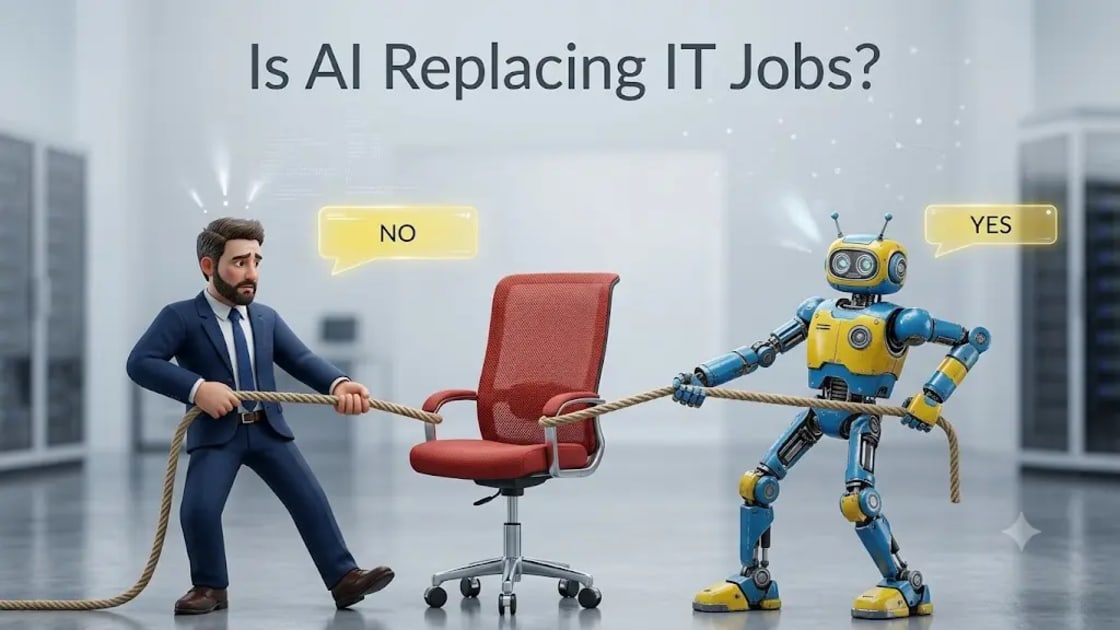
If you're studying IT right now, you've probably felt a bit of dread every time a headline pops up about layoffs "because of AI." It's a fair thing to worry about. So let's actually answer it: is AI taking over IT jobs, or is this mostly noise?
The honest answer is a bit of both. AI really is wiping out certain kinds of tech work. At the same time, it's creating brand new kinds of work that didn't exist a few years ago. The students who figure out which is which and plan around it are going to come out ahead. At Zia EdTech, we get this question from students all the time, so let's break it down properly.
Is AI actually taking away IT jobs?
Yes, but not evenly across the board. A lot of the tech layoffs happening in 2026 are being blamed directly on AI or automation. In fact, layoff-tracking firm Challenger, Gray & Christmas found that in March 2026, AI became the single biggest reason companies gave for cutting jobs in the U.S. a quarter of all that month's layoffs pointed to it.
The people getting hit hardest are freshers. Entry-level job postings have dropped 15% compared to last year. If you're a student who was hoping the first job would be the easy part, that's the uncomfortable truth showing up in the numbers, not just in your feed.
But here's the other side of it. The World Economic Forum, whose research on jobs is widely trusted, expects a huge amount of change by 2030 but they don't frame it as pure job loss. Their estimate is roughly 170 million new jobs created globally against 92 million lost, which nets out to about 78 million more jobs overall. So the honest picture isn't "AI is destroying IT jobs." It's closer to: boring, repetitive tech work is disappearing, and new kinds of tech work usually involving more judgment and more responsibility are taking its place.
Which jobs are actually at risk?
The jobs disappearing fastest all share one thing in common they're repetitive and don't need much thinking. If a job can basically be described in a simple flowchart, AI can probably do it now or very soon.
Here's what that looks like in practice:
Manual data entry — this is exactly the kind of pattern-matching work AI is good at, so it's shrinking fast.
Basic tech support — the "have you tried turning it off and on" tickets are increasingly handled by AI chat agents, not humans.
Simple manual testing (QA) — a lot of routine test-writing is now automated.
Basic admin and clerical IT work — routine reports, simple ticket sorting, and repetitive back-office tasks are easy automation targets.
Junior coding tasks that don't involve real decisions — turning a clear spec into basic boilerplate code is something AI coding tools now do reasonably well.
On the other hand, jobs that involve messy, unpredictable situations — where someone has to make a judgment call and be accountable for it — are holding up much better. That's a big reason why security, infrastructure, and systems work are proving more resistant than plain coding or support roles.
What Zoho's founder Sridhar Vembu is saying about freshers
It's one thing to read statistics from research firms. It's another to hear the same worry from someone who actually runs a major tech company. In early August 2026, Zoho co-founder Sridhar Vembu posted on X about exactly this issue. His point was that India's real challenge isn't just "keeping up with technology" it's making sure the economy still creates enough real jobs for people. He pointed out that India's IT industry, which used to be one of the country's biggest job creators, has clearly slowed down on hiring in recent years.
What's interesting is that he wasn't predicting mass layoffs. As one report on his comments explained, his worry was more specific than that: money that used to go toward hiring more people is now going toward AI infrastructure instead data centers, servers, computing power. That's happening at Zoho too, even though the company has managed to avoid layoffs so far. His real concern is India's huge population of young workers, and whether an industry that built millions of solid careers can keep creating that many entry-level jobs going forward. In his own words, the bigger danger isn't a wave of firings it's fewer doors opening for freshers in the first place.
This matters for how you plan your career. Big companies like TCS, Infosys, and HCL Technologies are still hiring freshers off campus they haven't stopped. But they've become pickier. They're leaning toward graduates who already show some real skill in AI, cloud computing, cybersecurity, or data instead of the old approach of hiring in bulk and training everyone from scratch later. So the door hasn't closed. It's just gotten narrower, and the next section is basically about how you widen your chances of walking through it.
Where the new jobs are coming from
While some jobs shrink, others are growing fast mostly around making AI actually usable and safe inside real companies. Career experts have pointed out that as routine jobs disappear, new roles are opening up around managing AI, checking its outputs, handling data ethics, and getting humans and AI to work together well.
In real terms, that means growing demand for people like:
AI and machine learning engineers — people who can actually build and train models, not just call an API and hope for the best.
MLOps / AI infrastructure engineers — the less exciting but very necessary job of keeping AI systems running properly and not blowing the budget.
Data engineers and analysts — someone still has to clean and organize the data every AI model depends on. Bad data in means bad results out, no matter how good the model is.
AI governance and ethics roles — as more regulation shows up around AI, companies need people who understand both the tech and the legal risk.
Cybersecurity professionals — especially people who understand new AI-specific threats like prompt injection or AI-generated scams and malware.
AI integration specialists — people who take a general AI tool and actually wire it into a company's existing systems and workflows so it's useful in practice.
Notice something about that list almost none of it is "build AI from scratch in a research lab." Most of it is about making AI work properly inside a normal business. That's a much more realistic goal for a student than becoming a research scientist, and it's where a lot of the actual hiring is happening right now.
A simple way to think about risk
Instead of asking "is my future job safe or not," it helps to think in three rough buckets:
High risk: data entry, manual QA/testing, basic tech support, simple report writing, junior coding jobs that are pure translation from spec to code with no real decisions involved.
Medium risk: general software development, project coordination, business analysis jobs with some routine parts and some judgment parts. These aren't disappearing, but they're changing shape as AI takes over the boring half.
Lower risk (for now): systems architecture, security, DevOps, ML engineering, data engineering, and anything that needs cross-team coordination or handling messy, high-stakes situations.
Keep in mind this will keep shifting. What's "medium risk" today might look different in two or three years as AI gets better at handling ambiguity. That's exactly why staying adaptable matters more than picking one job title you think is "AI-proof" forever.
What students should actually be learning right now
1. Don't skip the basics
AI can write code for you, but someone still has to know whether that code is actually correct, secure, and won't fall apart later. Programming fundamentals, data structures, databases, networking none of that has become optional. If anything, it matters more now, because you need to be good enough to catch AI's mistakes, not just accept whatever it gives you.
2. Learn to actually work with AI tools, not just use them casually
There's a real difference between typing a quick question into ChatGPT and knowing how to break a complicated task into steps an AI can reliably handle, checking its output properly, and understanding where it tends to go wrong. This is becoming a real skill employers expect, not just a nice-to-have.
3. Pick one thing and go deep
Trying to sound like you know a little bit of everything doesn't impress anyone anymore. Pick one area machine learning, data engineering, cloud, cybersecurity and actually build real things in it. A few solid projects in one area beats a resume full of buzzwords you can't really explain.
4. Get comfortable with data
Even if you never become a "data person," being able to look at data, clean it up, and explain what it means to someone non-technical is turning into a basic expectation, not a specialty. Doing a few real projects with public datasets goes a long way here.
5. Don't ignore the human skills
This is the part most students underrate. Being able to communicate clearly, think critically, and handle messy, unclear problems is exactly what keeps people valuable as automation increases. Someone who's technically solid and can explain their thinking, lead a discussion, or adapt when things go sideways is a lot harder to replace than someone with coding skill alone.
6. Build a portfolio, not just a transcript
A degree gets you in the door for an interview. A portfolio full of real projects something you built, broke, fixed, and can explain clearly is what actually convinces someone to hire you. Treat every project as proof, not decoration.
7. Know where AI gets things wrong
This one's underrated. AI tools confidently give wrong answers all the time. They can be biased, and they struggle badly with situations they haven't seen before. Understanding these limits and knowing when to double-check or add a human review step is genuinely valuable, because it's what separates someone who blindly trusts AI from someone who uses it responsibly.
What to expect over the next few years
Short term (2026–2027): more disruption in entry-level, repetitive jobs. Fast growth in roles around AI infrastructure and integration. Basic AI fluency starts becoming expected even in jobs that aren't specifically "AI jobs."
Medium term (2027–2028): working alongside AI becomes the default in most software jobs, so raw typing-speed coding matters less than good judgment, reviewing work carefully, and understanding system design.
Longer term (toward 2030): most serious research, including from the World Economic Forum, still expects overall job growth globally but the actual skills needed will keep shifting a lot. The tools will keep changing. Being able to adapt quickly is the one skill that doesn't go out of date.
Want a structured way to build these skills?
Reading about which skills matter is the easy part actually building them is harder, especially if you're piecing it together from random YouTube videos and half-finished courses. If you'd rather follow a clear, guided path through the skills covered above, take a look at the course catalog at Zia EdTech. It's built specifically to help students go from "I've heard of AI" to actually being job-ready for it.
Bottom line
AI isn't ending IT as a career it's changing what the job actually looks like. Boring, repetitive tech work is shrinking, and that's hitting freshers the hardest right now. But work involving building, securing, and managing AI systems is growing just as fast, if not faster. If you build solid fundamentals, actually learn to use AI well, pick one area to go deep in, and don't neglect communication and problem-solving, you're setting yourself up for the jobs being created not the ones disappearing. The safest move isn't avoiding AI. It's becoming the person who knows how to use it properly.