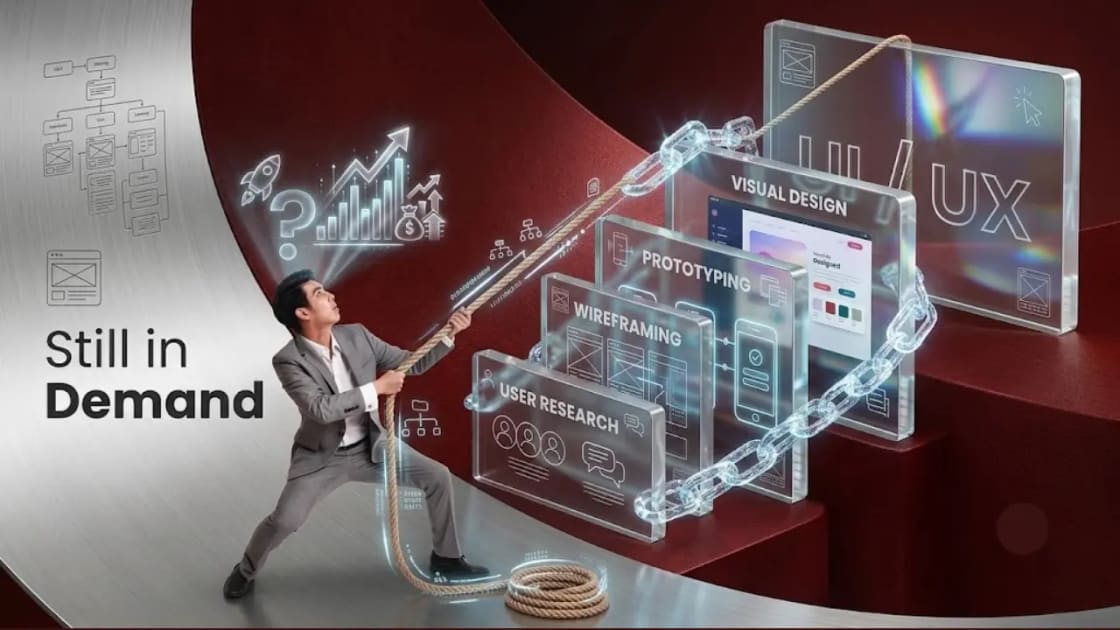
yes, UI/UX is still in demand in 2026 but the job itself has changed. Demand hasn't disappeared, it's redistributed. Companies still need people who can design usable, effective digital products, but they're far pickier about who that person is and what else they bring to the table beyond a nice-looking portfolio.
If you're a working designer, a career-switcher weighing whether to enter the field, a student choosing a major, or a hiring manager trying to build a lean design team, this post breaks down what's actually happening in the UX job market right now not the doom narrative flooding LinkedIn, not the hype either, just the real picture backed by current data.
Recent industry surveys back up the "still in demand" answer. A 2026 Figma survey of design leaders found that a large majority said their organization's need for designers had either grown or held steady, with several reporting double-digit growth in demand year over year. At the same time, research groups tracking the design job market note that while team sizes are stabilizing after a few volatile years, competition especially for junior roles remains tough, and each open role now tends to cover more ground than a similar role did five years ago.
Put simply: the demand curve is still up and to the right. The hiring bar just moved with it. Companies aren't hiring fewer designers because they've stopped valuing design. They're hiring more selectively because the definition of a "good designer" has expanded.
A quick reality check on the last few years
To understand where the market is now, it helps to remember where it came from. Between 2020 and 2022, the tech industry hired designers aggressively, often faster than product roadmaps could absorb them. When 2023 and 2024 brought budget corrections and layoffs across the tech sector, UX teams were hit alongside engineering and marketing. That correction not a collapse in demand for design itself is what created the "UX is dying" narrative that still circulates online.
Zoom out further, though, and the underlying need hasn't gone anywhere. Every company with a website, an app, or a piece of software still needs someone thinking about how real people use it. What changed is the excess: the market absorbed the oversupply from the boom years, and now it's settling into a more sustainable, more competitive equilibrium.
What's actually changed in the UX job market in 2026
1. Roles are more specialized and more consolidated at the same time
This sounds contradictory, but it isn't. Some companies, usually larger ones, want deep specialists: dedicated design-systems owners, standalone researchers, accessibility leads. Other companies, especially startups and lean teams, are compressing multiple design functions into a single hire who can do research, UI, and some product thinking all at once. Generalists who can flex between these modes are landing more offers than narrow specialists who say "I only design screens."
2. AI didn't kill UX it raised the floor
AI tools now handle a lot of the repetitive production work that used to eat up a designer's week: first-pass wireframes, copy variants, layout permutations, even basic prototypes. That hasn't erased the need for designers; it's erased tolerance for designers who only do production work. What's valued now is judgment — knowing why a design choice works for a specific user and business context, not just being able to produce one quickly. AI can generate ten versions of a screen in seconds. It can't tell you which one actually solves the user's problem.
3. Hiring managers are testing for ownership, not just craft
Portfolios full of polished final screens aren't enough anymore. Interviewers increasingly probe how a candidate handles ambiguous problems, messy or incomplete briefs, and pushback from stakeholders. Reliability under pressure being able to move a project forward without perfect information is becoming as important as visual skill. Hiring teams have shifted from asking "is this designer talented?" to "can I trust this designer when things are unclear?"
4. Junior roles are the tightest part of the market
If there's one place the squeeze is genuinely real, it's entry-level. The supply of new UX graduates and bootcamp grads still outpaces the number of junior openings, so early-career designers face noticeably more competition than mid-level or senior candidates. This is less about AI and more about a market correcting after years of oversupply at the bottom of the funnel.
5. Remote work has widened the talent pool and the competition
The normalization of remote work means companies can hire UI/UX designers from almost anywhere, which is good news if you're job hunting outside a major tech hub, but it also means you're now competing with a global pool of candidates rather than just people in your city. This cuts both ways: more opportunities, but also more competitors for each one.
Is AI replacing UI/UX designers?
Not in the way headlines suggest. AI is replacing specific tasks within the job rapid prototyping, generating layout variations, first-draft microcopy not the discipline itself. Someone still has to decide what problem is worth solving in the first place, interpret qualitative user research, weigh trade-offs between business goals and user needs, and judge whether an AI-generated screen actually makes sense for real people in a real context.
That judgment layer is exactly what's keeping UX relevant heading into 2026, and arguably making it more valuable, not less. The designers most at risk aren't the ones who use AI they're the ones who never developed the judgment AI can't replicate in the first place.
Skills that are actually in demand right now
Product thinking — connecting design decisions to business and user outcomes, not just aesthetics or trends
AI literacy — knowing how to use AI tools to speed up production without losing quality control or original thinking
Research fundamentals — running user interviews and usability tests, then synthesizing findings into clear design decisions
Design systems experience — building and maintaining consistent, scalable UI patterns across a growing product
Cross-functional communication — working directly with engineers and product managers, not just handing off finished files
Accessibility knowledge — designing for real-world compliance and inclusive use as a default, not an afterthought
Data comfort — reading basic analytics or A/B test results well enough to inform design decisions
None of this means UX as a field is losing relevance. It means the bar for being chosen is higher than it was during the post-pandemic hiring boom, and the gap between average and strong candidates has widened.
Freelance and contract UI/UX work in 2026
Beyond full-time roles, freelance and contract UI/UX work has held up well, partly because leaner in-house teams are outsourcing overflow work rather than hiring permanently. This suits designers who can work independently, manage client relationships, and deliver without heavy oversight the same "ownership" qualities that in-house hiring managers are now screening for. If full-time roles feel scarce in your market, contract work can be a realistic way to stay active, build a stronger portfolio, and get in front of more companies.
Where UI/UX demand is strongest by industry
Demand isn't evenly spread across sectors, and knowing where the growth is happening can shape where you focus your job search:
Fintech and healthtech — both remain strong hirers because usability directly affects trust, compliance, and error rates in high-stakes products.
B2B SaaS — as more software companies compete on user experience rather than just features, product design roles keep growing here.
AI-native startups — companies building AI products need designers who can make complex, often unpredictable AI outputs feel understandable and trustworthy to end users.
E-commerce — conversion-focused UX work remains steady, since even small usability improvements translate directly into revenue.
Enterprise software — traditionally slower to modernize, many legacy enterprise tools are now investing heavily in redesigns, creating demand for designers comfortable with complex, data-dense interfaces.
Sectors that have cooled off somewhat include early-stage consumer apps and some traditional agency work, both of which were oversaturated during the earlier hiring boom and have since contracted.
How to stay competitive as a UI/UX designer in 2026
Show impact, not just output. Reframe portfolio case studies around problems solved and outcomes moved conversion rates, task completion, support tickets reduced not just final mockups.
Get comfortable with AI tools. Use them to speed up production work, and be ready to talk clearly about how you use them responsibly and where you still apply your own judgment. If you're building these skills from scratch, a structured, mentor-led option like the UI/UX design course at ZiaEdTech covers AI-assisted workflows alongside research, prototyping, and design systems fundamentals.
Build research muscle. Even basic, scrappy user research experience sets you apart from portfolio-only candidates who never talk to real users.
Widen your range slightly. You don't need to become a product manager, but understanding business goals and technical constraints makes you significantly more hireable. Designers who understand how their work actually gets built collaborate better with engineering teams even a basic grasp of a stack like the one taught in Zia EdTech's full stack development (MERN) course can bridge that gap without turning you into a developer.
Practice explaining your thinking. Interviews increasingly test judgment under ambiguity — rehearse talking through messy, real decisions, not just polished final outcomes.
Specialize in something, eventually. Once you have solid generalist fundamentals, picking a focus area design systems, accessibility, research helps you stand out for senior roles.
Conclusion
UI/UX is still in demand in 2026 the survey data and hiring activity both support that conclusion. What's gone is the era where a good-looking portfolio alone was enough to land a role. The designers thriving right now are the ones who pair strong craft with clear thinking, comfort with AI tools, and the ability to own a problem end to end, from ambiguous brief to measurable outcome.
If you're already in the field or thinking about entering it, the smartest move isn't to panic about relevance. It's to close the gap between what you can produce and what you can explain through real projects, mentor feedback, and practice explaining your decisions out loud, which is exactly what a live, project-based training platform like Zia EdTech is built around.