What Is Data Science? A Clear Guide to How It Works
Data science, is the practice of taking raw data and turning it into something people can actually use to make decisions. It's a mix of statistics, programming, and real-world knowledge of whatever industry the data comes from. And honestly, you've already benefited from it today, whether you realized it or not — that's how your streaming app knows what you'll want to watch next, and how your bank catches a weird charge on your card almost instantly.
The term gets thrown around constantly, usually mashed together with "AI" and "machine learning" until the whole thing sounds like one giant buzzword. But data science is its own field, with a process that's a lot more grounded than the hype suggests. Let's walk through what it actually means and how data science works, step by step.
What Does Data Science Actually Mean?
In simple terms, data science means turning raw information like clicks, purchases, sensor data, medical records, whatever into something useful.
There are really three things at play here:
Statistics, which helps make sense of patterns and probability
Programming, which does the heavy lifting on large datasets
Domain knowledge, meaning you actually understand the industry the data is coming from
Here's the thing, though none of these on their own gets you very far. A statistician who can't code is going to struggle the moment a dataset grows past a few thousand rows. A programmer with zero industry context might build something technically impressive that nobody ends up using. Data science sits right at the overlap of all three, which is part of why good data scientists are genuinely hard to find. If you want to build that overlap of skills yourself, Data Science and AI/ML course is a solid place to start.
How Does Data Science Work? The Data Science Process, Step by Step
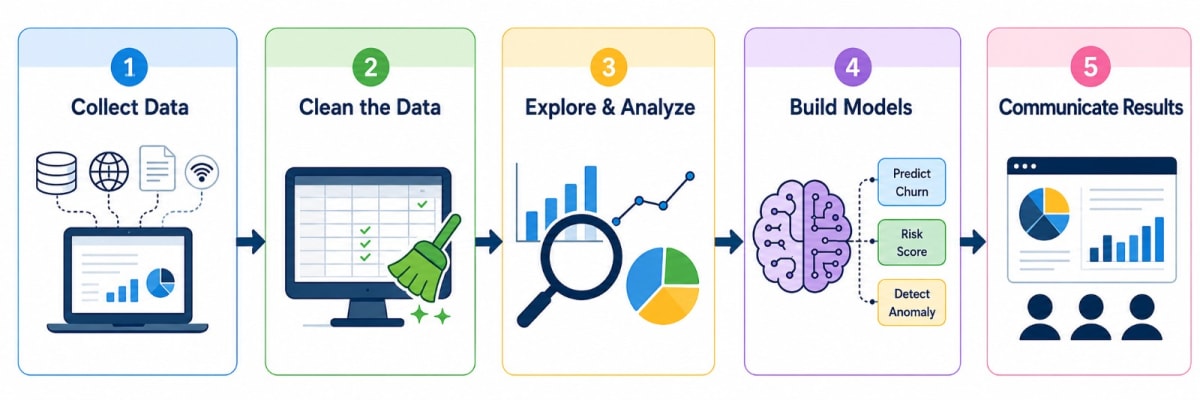
The data science process usually breaks down into five stages. But in real projects, teams don't follow them in a straight line, they often jump back and forth between steps as new problems come up.
First, you collect the data. Maybe it's sitting in a customer database already, maybe it's coming from website logs or sensors or surveys. Sometimes there's a mountain of it just waiting to be used. Other times, someone has to build the pipeline from scratch just to start gathering it.
Then comes cleanup - and it's rarely anyone's favorite part. Raw data is messy. Missing values, duplicate rows, formatting that doesn't match from one source to the next. Cleaning it up almost always eats more time than the actual analysis. Data scientists spend most of their time cleaning data .
Next, the real digging starts. This is where someone looks through the data to find patterns and connections. Charts and graphs make this easier, since spotting a trend in a picture is much simpler than finding it in thousands of rows of numbers.
After that, models get built. After the analysis, the next step is building a model. This is usually where machine learning comes in. A model is trained on past data to make predictions about new situations.
For example: A bank might build a model that reviews a loan applicant's income, credit history, and spending patterns to predict how likely they are to repay the loan on time.
And finally, someone has to explain it. Even the best model is useless if no one understands what it's saying. The last step is turning technical results into something a business leader can actually use , usually through a dashboard, a short report, or a brief conversation that leaves out the complicated math.
Why Data Science Matters
Not long ago, most business decisions were based on instinct and experience. That's not necessarily a bad thing , an experienced manager's judgment has real value, but it has limits. It doesn't scale well, and it's easy to miss patterns that only show up when you're looking at millions of data points at once.
Data science changes that. Instead of guessing what a customer might want, a company can look at what they've actually done. Instead of catching fraud after it happens, a bank can flag it the moment it occurs.
That shift from assumption to evidence is really the whole point of the data science process.
Real-World Data Science Examples
Chances are you've run into real data science examples more than once today already:
E-commerce - personalized recommendations, dynamic pricing
Healthcare - catching risks earlier, tailoring treatment plans
Banking - fraud detection, credit risk scoring
Retail - inventory forecasting, demand planning
Marketing - figuring out who's actually worth advertising to, and predicting who might churn
Common Data Science Tools
The exact data science tools you'll use shift from company to company, but a handful of names keep coming up:
Python and R for analysis and statistics
SQL for pulling data out of databases
Tableau or Power BI for building dashboards people can actually read
TensorFlow and Scikit-learn when machine learning enters the picture
Jupyter Notebooks, where a lot of the early experimentation tends to happen
None of these data science tools do the thinking for you, though. They're instruments, not answers. The actual skill is knowing which question is worth asking in the first place.
Job Opportunities and Salary in Data Science
Data science jobs are everywhere right now, and that's not likely to change soon. Companies in almost every field like tech, healthcare, banking, retail are hiring for roles like data analyst, data scientist, machine learning engineer, and data engineer. If you're just starting out, you'll probably spend most of your time cleaning and organizing data. Move up the ladder, and the work shifts toward building models and helping leadership make bigger decisions. Job growth in this field is expected to be much faster than average over the next several years. If you're thinking about breaking in, Master in Data Science & AI/ML program covers the exact skills employers are hiring for right now.
Data Science Salary in India
Honestly, if you ask ten people what data scientists earn in India, you'll get ten different answers, and most of them will be right, just for different situations. Freshers typically land somewhere around ₹4–8 LPA to start. That said, if you're coming out of an IIT or IIM, or you've actually built a few solid projects instead of just finishing coursework, you can push well past that. Put in three or four years, and pay usually moves up to the ₹10–20 LPA range. Get further along, especially if you're working with AI or machine learning, and ₹30 LPA or more isn't unusual. Where you live plays a role too. Bangalore and Hyderabad tend to pay noticeably better than smaller cities. And here's something worth knowing if you're weighing offers: product companies almost always pay more than IT services firms for the same job title. One thing that's become pretty clear lately , anyone with real, hands-on AI or Gen AI skills is out-earning generalist data scientists by a fair margin. That's exactly the gap our AI/ML - focused data science course is built to help you close.
Is Data Science the Same as AI?
Not quite, though the two definitely overlap once you understand how data science works underneath the hood. Data science is the broader umbrella , it covers everything from basic statistics to advanced machine learning models. AI, and machine learning specifically, is one tool inside that toolbox, not the whole thing. Plenty of data science work never touches AI at all. Sometimes the entire project is just cleaning up a messy spreadsheet and running a basic regression, and that still counts as data science.
Final Thoughts
Looking back at these data science examples, it's clear data science isn't some mysterious, futuristic thing reserved for tech companies with unlimited budgets. It's a practical process built on curiosity, a bit of math, and genuine understanding of whatever problem is sitting in front of you. That personalized recommendation, that fraud alert, there's a decent chance data science had a hand in it somewhere along the way.
As more industries lean into this kind of decision-making, understanding at least the basics of how it works is turning into something closer to everyday literacy, not just a technical specialty for peoples. At Zia EdTech, we help people build exactly these kinds of practical, real-world skills.